How I integrate Claude, GitHub Copilot, and Microsoft Copilot across my enterprise UX workflow to synthesize faster, document better, and spend more time on the parts of design only a human can do.
The integrated AI tools I've been using.
Enterprise SaaS design carries a heavy load of non-design work. Interview notes pile up faster than they can be synthesized. Documentation gets forgotten as soon as it ships. Evidence gets buried in decks, and the thread from a research finding to a design decision gets lost.
The result is a familiar tax: senior designers spending disproportionate time on synthesis, formatting, and record-keeping instead of on customer understanding and design judgment.
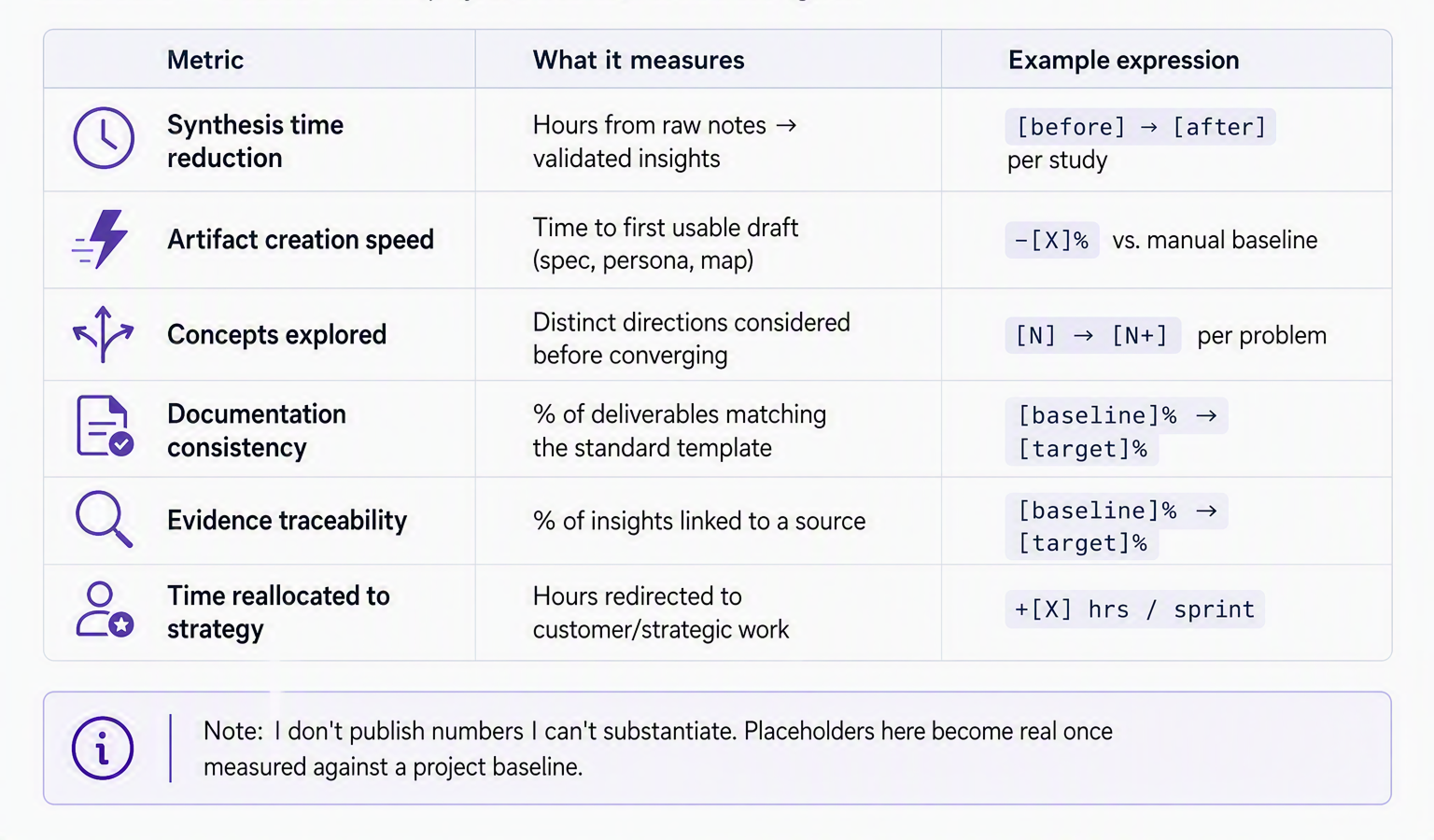
I didn't adopt AI to produce design for me. I adopted it to remove friction from the work around design. Each tool earns its place by doing something measurably faster or more consistently than I can by hand, while leaving the judgment calls with me.
The approach. I treat AI as a first-draft engine and thinking partner. Every AI output is manually reviewed. I check the evidence, challenge assumptions, and flag anything unsupported. AI lets me digest a lot more data but I'm accountable for what is true and what ships.
.png)
Generated using DALL-E 3 based on my working process
%20(2).png)
Generated using DALL-E 3 based on my working process

Generated using DALL-E 3 based on my working process
A Knowledge Management System Loop
I use a tool called Obsidian to structure my work and capture notes because it creates markdown files by default. I store project instructions for Claude and custom skills including one that captures key decisions from Claude cowork into a memory file to help address the issue of context limitations.
I'm making continual improvements in my AI workflows as I learn more. I'm not interested in AI that replaces designers. I'm interested in AI that gives good designers more room to do their best work. If that's the kind of practice your team is building, let's have a chat.
.png)
A screenshot of my Obsidian folder structure
Responsible AI Philosophy
I use AI to expand what I can explore and to remove friction from the work around design, not to outsource judgment. I keep evidence traceable, state confidence honestly, challenge my own assumptions, and treat every stakeholder as a person rather than a data point. The measure of this workflow isn't how much AI does; it's how much better the human decisions get.