Designing for awareness
Validating assumptions to dodge compliance issues and raise donor awareness.
+49% donor awareness
Critical risks mitigated
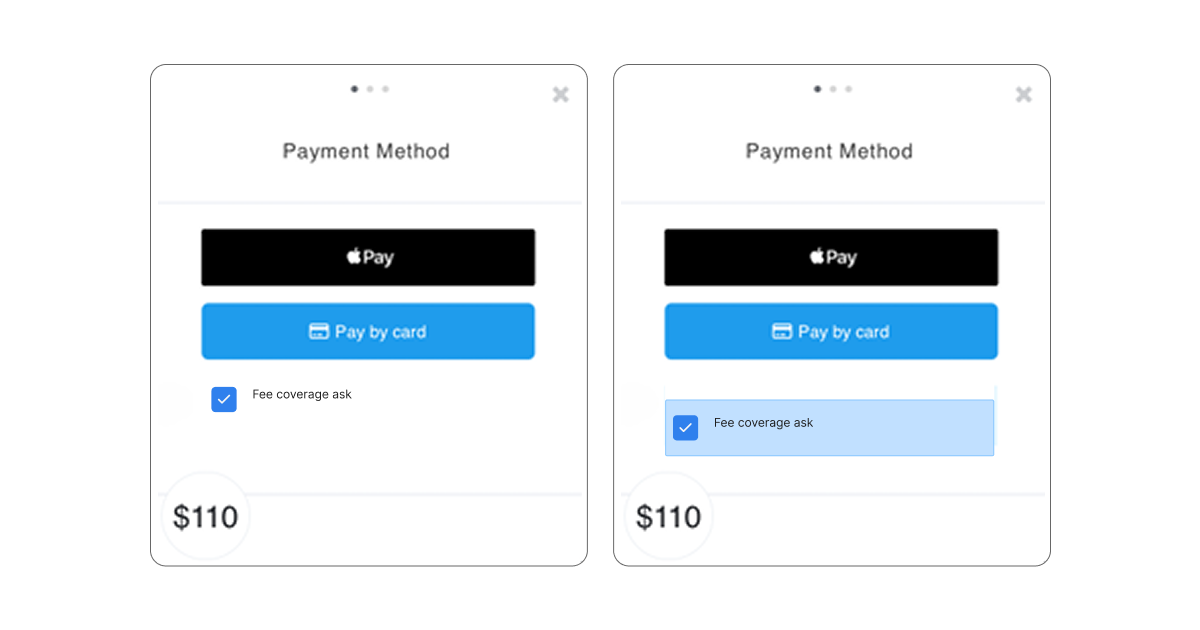
Checkout before and after usability testing.
Validating assumptions to dodge compliance issues and raise donor awareness.
There's a real cost to process online transactions (security, speed, etc.) and those fees eat into total donation received by nonprofits. Donor cover is where donors can pay for the processing fees.
Complete Cover is a feature offering to help organizations offset processing fees. Blackbaud covers the fees for eligible payments in exchange for asking donors to voluntarily add an extra tip (in addition to processing fees) to support their business. Nonprofits receive the full payment regardless of whether a donor contributes.

We talked with 18 donors segmented across age, gender, ethnicity, and last donation amount. The business wanted to use a pre-checked checkbox and display it on the same page as other fields.
We tested three user flows, two that asked for the voluntary contribution on a separate step and one that showed the ask combined with another step. We also reviewed sentiment surveys.
During our follow-up discussion, we learned that participants did not understand what the ask was really saying. Many thought it was meant to cover just the processing fees but the model is meant to contribute toward Blackbaud as the software provider. Seeing the name "Blackbaud" was very confusing to participants and seeing the language for "tips" left a bad impression. There was also a good deal of negative feedback observed in a donor sentiment survey that was running during this time.
Negative feelings about how Complete Cover is implemented can lead donors to blaming the nonprofit and that leads to nonprofit customers blaming the business.
Based on definitions from the FTC and the EU, the proposed design pattern from flow C could be deemed to be deceptive.
Donors give based on their budget and if they're unaware of an extra contribution, it can cause financial burdens and strained relationships with a nonprofit.
...the term "dark patterns" has been used to describe design practices that trick or manipulate users into making choices they would not otherwise have made and that may cause harm. As the workshop's panelists noted, dark patterns often take advantage of consumers' cognitive biases to steer their conduct or delay access to information needed to make fully informed decisions.
During testing, there was intense internal pressure to experiment with a “Complete Cover” fee model - asking donors to leave a voluntary “tip” to Blackbaud with a pre-checked box with an intentionally low visual weight. I led the defence. Two usability tests demonstrated that donors found the pattern deceptive and that it lowered overall donation amounts. I brought the findings to Legal and Compliance, framing the issue as regulatory risk, not just a usability opinion.
As a result, the optimization team created two new KPIs that permanently redefined how “winning” tests are determined. One was a focus on donor sentiment and the other ensured we were accounting for the total revenue the nonprofit receives not just a simple conversion rate.
Lessons Learned: In highly regulated enterprise environments, your most valuable design partners may sit outside the product org. I could have saved weeks of friction by involving Legal and Compliance at the beginning, not the end. Bringing up regulatory risk was what shifted our approach.